
Will AI replace digital marketers?
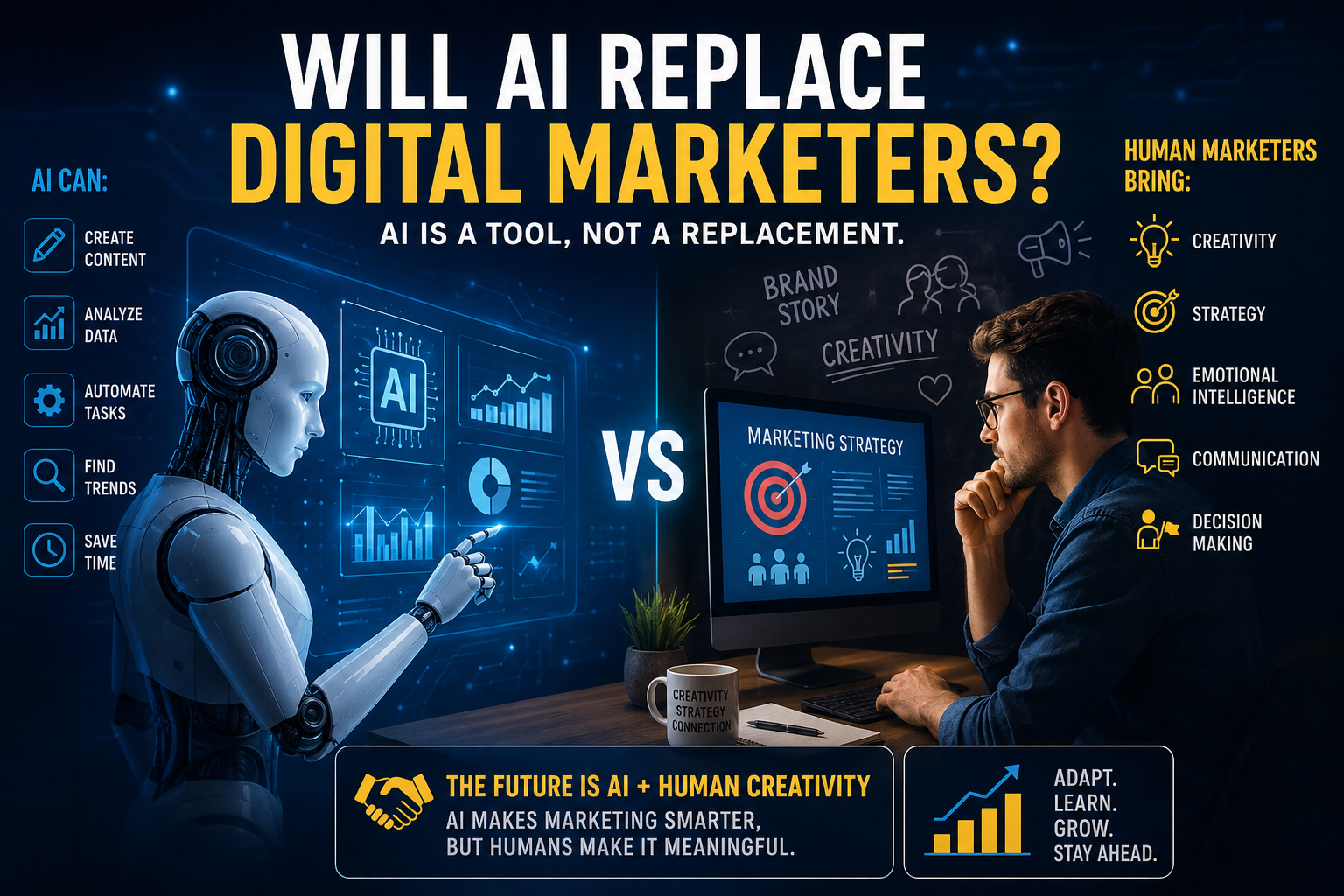
Artificial Intelligence (AI) is changing the digital marketing industry very quickly. AI tools can now create content, analyze data, generate images, automate tasks, and help businesses understand their customers. Because of this, many people ask an important question: Will AI replace digital marketers?
The simple answer is No, AI is unlikely to completely replace digital marketers. However, digital marketers who know how to use AI may replace those who do not adapt to new technology.
AI is extremely useful for handling repetitive and time-consuming tasks. For example, AI can help marketers generate content ideas, write basic content, analyze keywords, create social media posts, study customer behavior, and identify trends. It can also analyze large amounts of data much faster than humans. This allows marketers to save time and focus on more important activities.
However, digital marketing is not only about creating content or analyzing numbers. A successful digital marketer needs creativity, strategy, communication, emotional understanding, and decision-making skills. These are areas where human involvement is still very important.
For example, AI can generate a social media advertisement, but a digital marketer needs to decide who the target audience should be, what message will connect with them, which platform should be used, and what business goal the campaign should achieve. AI can provide suggestions, but the marketer needs to understand the business and make the final strategic decisions.
Another important factor is creativity. AI can create impressive content, but human creativity is still important for developing unique brand ideas, understanding cultural trends, creating emotional connections, and building a strong brand identity. People often connect with stories, experiences, and emotions, which require human understanding.
AI also depends heavily on the information and instructions given to it. If a marketer gives poor instructions or does not understand marketing fundamentals, AI may produce content that looks good but does not achieve the desired business results. Therefore, understanding marketing principles remains essential.
In the future, the role of digital marketers may change. Instead of spending most of their time on repetitive tasks, marketers may use AI as a powerful assistant. For example, an SEO professional can use AI for keyword ideas and content analysis, while focusing on SEO strategy and user experience. A social media marketer can use AI to generate content ideas but focus on audience engagement and campaign strategy.
AI can also make digital marketing more competitive. Businesses may be able to create content faster and analyze customers more efficiently. This means marketers will need to develop stronger skills in areas such as strategy, analytics, branding, creativity, communication, and AI tools.
The future is therefore not necessarily “AI vs. Digital Marketers.” It is more likely to be “AI + Digital Marketers.” Marketers who learn how to work with AI can become more productive and effective.
For example, imagine two digital marketers. One refuses to use AI and spends several hours doing repetitive research and content tasks. The other uses AI to complete those tasks quickly and spends the saved time improving strategy, creativity, and client relationships. The second marketer may have a significant advantage.
However, this does not mean that every digital marketer will automatically have a successful career. Some basic tasks in digital marketing may become increasingly automated. Jobs that mainly involve repetitive content creation, simple data analysis, or routine tasks could be affected by AI.
This means digital marketers need to adapt and continuously learn. Learning AI tools should become an additional skill rather than a replacement for marketing knowledge. A marketer who understands both digital marketing and AI can potentially offer more value to businesses.
In conclusion, AI will change digital marketing, but it is unlikely to completely replace digital marketers. Instead, AI will automate many routine tasks and help marketers work faster and smarter. Human creativity, strategy, emotional understanding, communication, and decision-making will continue to play an important role.
The real question is not “Will AI replace digital marketers?” The better question is “Will digital marketers learn to use AI?”
The future belongs to marketers who can combine human creativity with AI technology. AI is not necessarily the enemy of digital marketers—it can be one of their most powerful tools.